FAQ

How long is the corridor?
What is the schedule and how long will it take to build?
This corridor has been talked about for a long time. Is it really going to be built this time?
Will graves need to be moved?
Is there anything that works to slow down all the reckless driving and speeding?
Why is it being constructed?
Why is moving the exits and entrances to the right so important?
Why can’t you just build a reversible/commuter lane?

still have questions?

Couldn’t find an answer to your question? Submit your comment here.
ask us

still have questions?

Couldn’t find an answer to your question? Submit your comment here.
submit your question

Multimodal User Resources

Find helpful info on local transit, bike routes, carpooling, regional bus lines, and more!

select a topic below to learn more

Bikes and Trails
Buses, Shuttles, and Transit
Carpools and Ride Sharing

Local Trails

A nearby local resource are local trails which run parallel to the I-94 East-West corridor. Trails are a great option for people who walk or bike to work or recreation in the area.
The Oak Leaf Trail (OLT) has seven primary “branch lines” and is managed by Milwaukee County. The Menomonee Line is the closest OLT line to the I-94 East-West corridor.
The Hank Aaron State Trail (HAST) is a 14-mile paved east-west connection managed by the Wisconsin Department of Natural Resources and supported by the Friends of the Hank Aaron State Trail.
For additional biking opportunities, the City of Milwaukee‘s bike map is a helpful resource.

Bublr Bike has a map of their locations here.

    MCTS Routes Impacted by Construction

    WisDOT has committed transit mitigation funds as part of the I‐94 East‐West program. Mitigation funds are used to solve a problem: alternate routes become more congested during construction, so project funds may be used to mitigate that situation. For the 2025-26 contract with Milwaukee County Transit System (MCTS), nearly $5 million is allocated for the following: service frequency, paratransit services, additional operators, transit marketing, and design of a new BRT station. MCTS is coordinating with WisDOT and the project team to manage bus service disruptions and provide advance notice to riders. MCTS is the largest transit agency in Wisconsin, and is the primary transit provider for Milwaukee County.
    At varying stages of the project, corridors with anticipated congestion and/or detour impacts include:
    • Wisconsin Avenue - Route 30 and CONNECT 1 BRT
    • 16th Street - Route 24
    • 27th Street - PurpleLine
    • 35th Street - Route 35
    • 43rd Street/Miller Park Way/WI175 - Route 74
    • National Avenue - Route 18
    • Hawley Road - Route 60
    • 68th/70th/Kearney/O'Connor Streets - Routes 76& 44U
    • For the latest boarding information and trip-planning updates, please visit RideMCTS.com/Alerts or use the Umo app.
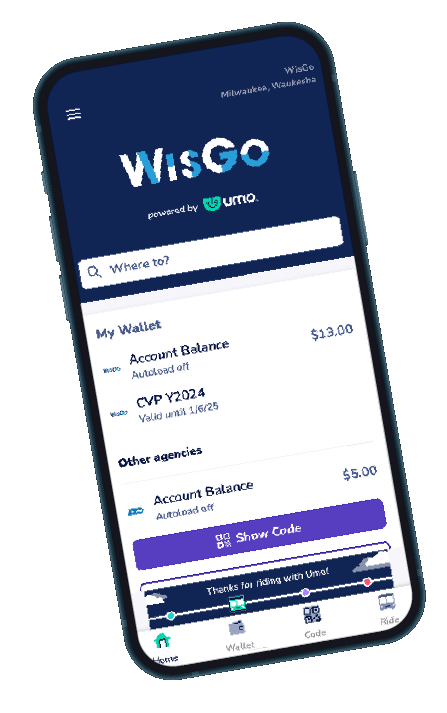
    A mobile phone showing a screenshot from the WisGO app.

    Learn more at

    https://www.ridemcts.com/alertsQR code for www.ridemcts.com/alerts
    Or scan using a mobile camera

    MCTS – Connect 1 Bus Rapid Transit

    With construction mitigation dollars, WisDOT is providing $200,000 in funding for the design of a new Connect 1 station.
    For information on Connect 1 schedules, check the MCTS website.
    A mobile phone showing a screenshot from the WisGO app.

    Learn more at

    https://www.ridemcts.com/alertsQR code for www.ridemcts.com/alerts
    Or scan using a mobile camera

    Regional Transportation Options

    There are many regional transportation options for moving through and around the I-94 East-West corridor.

    Special Event Shuttles in the Corridor

    Plan your visit for shuttles, ride sharing, directions and parking at corridor tourist destinations:

    FlexRide Milwaukee

    FlexRide Milwaukee is an on-demand workforce transportation service for $3.00 or less. Check the website for information on how to ride, how to register, how your business may be involved, and more!
    CommuteWISE encourages people to use alternatives to driving alone through an online carpool matching and trip planning platform. Sign up, enter your home and work destination, and connect with coworkers or neighbors with similar commutes to form a carpool. CommuteWISE also hosts two challenges each year to celebrate sustainable commutes and other trips. Users log their trips in the platform during the challenges in the spring and fall and can win raffle prizes! Eligible trips include:
    • Carpooling and vanpooling
    • Public transit
    • Biking and walking
    CommuteWISE is supporting businesses with employees impacted by the I-94 EW project! For more information on transportation subsidies for transit passes, vanpools, carpools, and active transportation, click here.

    Park and Ride Lots; Ride Sharing

    Park and Rides are a safe and easy way to meet up with your carpool. Consider these area options:
    • State Fair Park and Ride at I-94 and 76th Street. Served by MCTS' 44U Fair Park line to UW-Milwaukee.
    • Goerke’s Corners at I-94 and County Y. Served by regional transportation options with connections to downtown Milwaukee and beyond.
    • Watertown Plank Road. Served by MCTS’ CONNECT 1, which connects the Park and Ride lot users with Wauwatosa and Milwaukee neighborhoods and businesses, Marquette University, downtown Milwaukee, and the lakefront.
    • I-894/43/STH100 in Hales Corners. Served by MCTS’ 44U Fair Park, to UW-Milwaukee, and 55 Line, which connects the Park and Ride lot users to Cudahy and Saint Francis.
    • I-94/I-41 and College Avenue. Served by MCTS' 40U College line to UW-Milwaukee.
    For other Park and Ride options, see WisDOT's Park and Ride Lots page.
    Local Trails
    MCTS Routes Impacted by Construction
    MCTS – Connect 1 Bus Rapid Transit
    Regional Transportation Options
    Special Event Shuttles in the Corridor
    FlexRide Milwaukee
    CommuteWISE
    Park and Ride Lots; Rideshare

    Environmental Documents

    Take a look through the project's environmental documents from the start of the project in 2012 through today.

    Environmental Milestones: 2016 to Present

    WisDOT has been and will remain committed to a robust and transparent public process.
    2016
    In September 2016, the Federal Highway Administration signed a Record of Decision (ROD) for the I-94 East-West Corridor Study.
    2017
    In October of 2017, the ROD was rescinded due to a lack of available funding.
    2020
    In July 2020, Governor Evers announced the renewed focus on the project.
    2021
    • In April 2021, WisDOT announced it will expand its review of the project by conducting a supplemental Environmental Impact Statement to allow more study and public input.
    • Preparation of the supplemental Environmental Impact Statement was started.
    • On June 15, 2021, the Federal Highway Administration issued this Notice of Intent in the Federal Register. This notice is a formal step in the process to advise the public that a supplemental environmental impact statement (SEIS) will be prepared for a proposed freeway corridor improvement project on I-94 from 16th Street to 70th Street in Milwaukee County, Wisconsin. View Notice of Intent in Federal Register.
    • In fall 2021, supporting information regarding the needs for the project were updated to reflect current conditions. The Purpose and Need describes the reason why the project is being considered. Purpose and Need factors for the I-94 East-West Corridor study remain the same as stated in the 2016 Final Environmental Impact Statement.
    2022
    • In spring 2022, the project's Coordination Plan for Agency and Public Involvement document was updated.
    • This project’s environmental review process must ensure that environmental information is available to public officials and citizens before decisions are made and before actions are taken. The purpose of this Coordination Plan is to communicate how and when the Lead Agencies will coordinate public and agency participation and comment in the environmental review process for the I-94 East-West Corridor Study. This plan is intended to be a dynamic document that will be available to stakeholders and updated as appropriate throughout the duration of the project.
    • View Coordination Plan for Agency and Public Involvement (updated summer 2023).
    • Summer of 2022 provided an Updated Range of Alternatives Summary.
    • Fall of 2022, the Supplemental Draft Environmental Impact Statement became available for review and two public hearings were held in December 2022.

    Additional Resources

    Kids Corner

    Information and activities for young minds

    Project Journey

    Here is a brief journey through the 94 East-West project!
    Study
    Approval
    Design
    Build

    Activities

    With parents permission, click the following links to view, download, and print fun coloring materials!

    Activity Book

    Libro De Actividades

    Project Video

    Video is appropriate for all audiences.

    word search

    travel maze

    A fun maze for children to solve and color.

    What is an Environmental Impact Statement?

    After years of study, we completed a document called a "Supplemental Environmental Impact Statement." What does that mean and what was included?
    • Taking Care of Nature: Looking at new rules that protect the environment and checking on new types of animals or plants that need extra care or consideration.
    • Checking the numbers: Making sure we have the right information about how many vehicles (cars, trucks, buses) might use the roads in the future.
    • Thinking of new ideas: Coming up with different plans that match the new information and taking into consideration what people in the neighborhood think about the plans.
    • Making things better for everyone: Trying to connect neighborhoods so people can easily go to work or have fun, and thinking about how many lanes the roads should have to make sure people can move around safely.
    • Including everyone: Making sure everyone's ideas and thoughts are considered. Sometimes the answer is “no, we can’t do that”, though we really welcome ideas and opinions.
    • Looking at different ways to travel: Checking if there are other cool ways, like walking or biking, to get around town besides just using cars. Where we can, we help make it safer for bikers and walkers too.
    Back to top scroll button